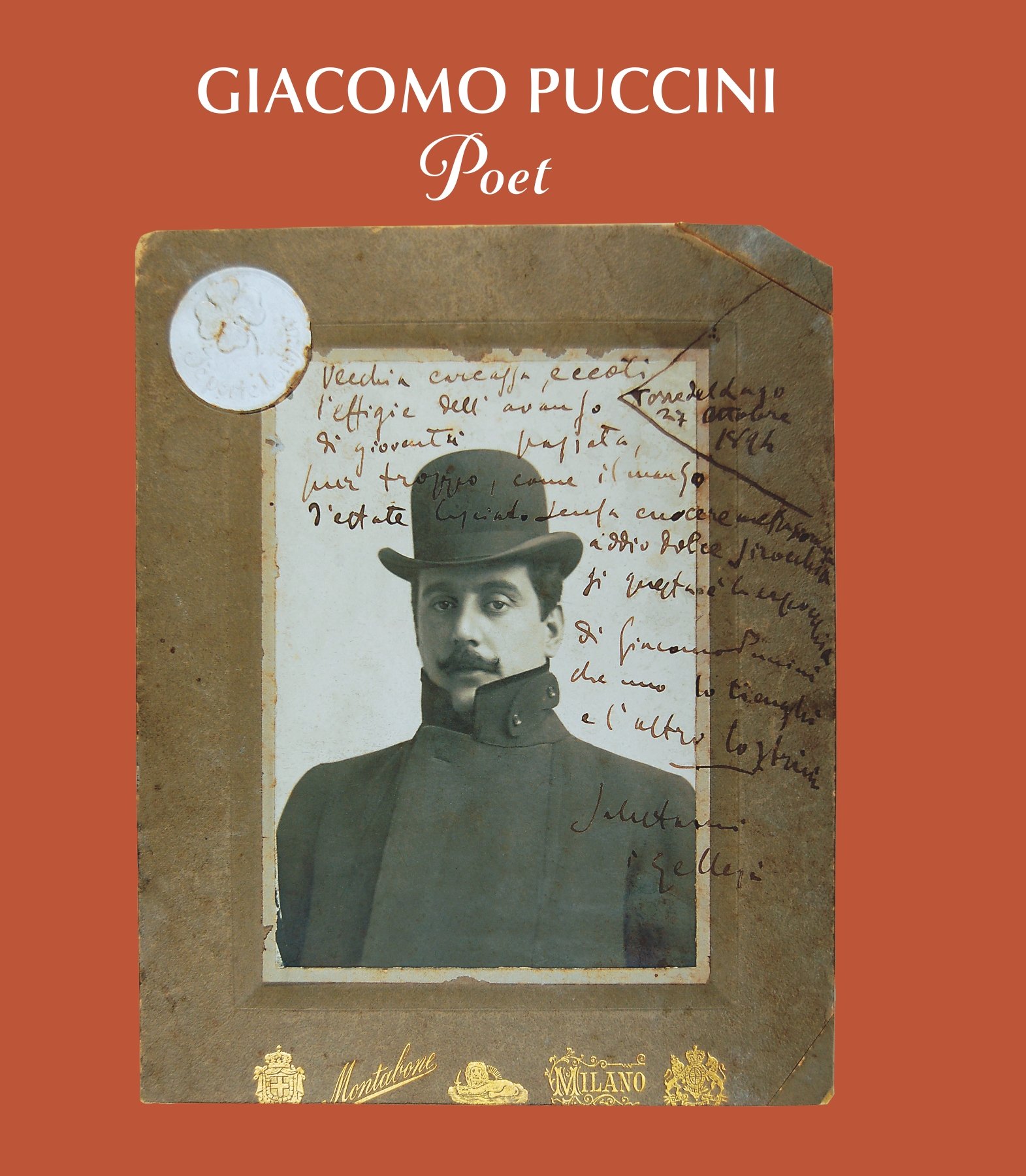
Description
Puccini poeta was published in the year that marks the centenary of Giacomo Puccini’s death, which took place in Brussels on November 29, 1924. Centenarians, both those institutionalized with administrative acts and public resources, and those who are nourished by the mere memory of the anniversary, have the merit and the duty to impose an in-depth reflection on the cultural legacy of the celebrated. In the case of Giacomo Puccini, this task has even deeper motivations and knots still to be untied. The profile historically consolidated after his death is now pervasive and the tireless work of scholars and researchers has not yet completely scratched the superficiality of widespread and persistent judgments.
In 2018 the Licia and Carlo Lodovico Ragghianti Foundation created the exhibition “For dreams and chimeras”. Giacomo Puccini and the visual arts.
The friendly and professional relationships between Giacomo Puccini and the painters have long been presented and investigated. The original nucleus of the lake’s bohemians and its subsequent extension to new occasional or lasting participations has been the subject of exhibitions, studies and documents.
The same involvement of some of these painters in the artistic choices of the installations and in the decorative imaginations of the Master’s homes has also been investigated. The restoration work of the Villino Giacomo Puccini in Viareggio is likely to increase this inclination with new details. The 2018 exhibition had the original merit of deepening the relationship between Giacomo Puccini and the visual arts from a critically new perspective.
The punctual restitution of relationships with gallery owners and collectors, the documented personal commitment to patronize his appreciated artists, as well as the critical considerations addressed to their work, refer to the constant attention and expression of a “taste” and a personal aesthetic approach to the figurative arts, which transcends the chronicle of friendships and biographical entanglements.
During 2024, the Ragghianti Foundation itself organized the exhibition “What eye on the world”. Puccini photographer.
The exhibition consisted of ninety photographs “taken” by the Maestro and preserved in the Puccini Archive of the Simonetta Puccini Foundation for Giacomo Puccini in Torre del Lago and in other funds. The subjects photographed represent the places inhabited and lived by Giacomo Puccini – Abetone, Ansedonia, Chiatri and Torre del Lago – alternating glimpses of landscapes and moments of family life. Other “shots” accompany his trips to Egypt, Paris, New York, just as his passion for photography follows the Master for thirty years starting in 1894. This activity also expresses an attitude that goes beyond the tension towards modernity and the fascination aroused by the prodigious machine, which certainly intrigued him, and shows the progressive skill in its use and the improvement of the technique. The series of themes almost suggests in some cases the sequential intent of the reportage and the awareness of the expressive and aesthetic value of the medium, which will also become a useful tool for a suggestion and a scenographic indication.
The relationship between Giacomo Puccini and the word is equally intense. “Writing music for the theatre” – to quote the Maestro’s creative imperative – means interweaving the devotion that is due to Euterpe with the veneration of Calliope, Melpomene and Polyhymnia and with the reverence for the smiling mask of Thalia.
The combination of music, song and poetry is manifested in the refined correspondence between the hyphenation and the rhythm contained in the phrase with the musical composition and, of course, vice versa. From this warp springs poetry from the “Homeric” aedes to the medieval troubadours. If, as is opportunely noted in the Introduction, the education in the Latin classics, the nursery rhymes sung with his sister Ramelde and the Christmas memory of Carlo Paladini are manifestations of a precocious poetic nature, it cannot be denied that the artistic imperative leads the Maestro to a constant creative confrontation with the poets.
If we make – perhaps – an exception for Giovacchino Forzano and Giuseppe Adami, all his librettists had been poets or were. Their collections or occasional appearances in magazines and gazettes are not to be found in the pantheon of poetry anthologies. Their commitment to versification was, however, constant and dense with personal and original registers. They were the irregular Luigi Illica, the young crepuscular Guelfo Civinini, the professor Carlo Zangarini and the humorist with popular accents Renato Simoni. The deep friendship between the playwright Giuseppe Giacosa and Giovanni Pascoli is attested by a substantial correspondence full of poetic references, which consolidated their relationship to such an extent as to inspire the singer of Castelvecchio a poem dedicated to the death of the great librettist by Giacomo Puccini:
Thus! Thus! your Parella
your home, your Maria…
Thus death is beautiful:
it is not leaving, it is never going away.
He sang all night a chorus
of witty trills and low notes;
and the golden
full moon shone on the bed where you rested.
At dawn a great
smell spread in the porch: your cloister
was full of garlands:
one said: to dear Pin, who is ours.
A gift was gentle, of villa.
Everyone wanted to give something.
They changed a drop
of their sweat into a rosebud.
At the Chief, the housewives, quick
descending as he passed the stairs,
they handed the rural money,
the white egg that is given for salt.
And you with all of them in a row
You descended between the green hedges
to your church; and there was
a smell of sepulchres or nativity scenes,
and the sound of pain in peace,
which wants to become more much,
which is loved, which is liked,
there was the sob that finds crying again.
And all in tears and all to the sweet cry
of your bells,
they moved: their old dog went next
to the peasants.
And you reached your people
already near the sweet noon.
Under the leaning
roses you entered. Green beech trees were around.
The scythe had
opened the way early in the morning among the tall grasses
. Mint and thyme
made everything smell good in summer.
And you stayed. You don’t die
like that. So, my good brother,
we stay. To your great heart,
Stop! perhaps you said: It is beautiful…
“We master composers,” Puccini wrote to the critic and composer Carlo Cordara, “are like bees, honey is sucked where the sweet and the good are found.”
The difficulty of deliberating “the sweet and the good” from the poetry laureate is well known. The comparisons with Giovanni Verga and Gabriele d’Annunzio did not result in the expected works.
La lupa, Parisina, La rosa di Cipro and La crociata degli innocenti were all projects on which the aspiration to collaborations that alternated availability and disappointment, expectation and rejection, enthusiasm and disappointment was consummated. The impossibility of concluding the work begun with Gabriele d’Annunzio touches heartfelt and profound registers and marks the understanding of a drastic distinction, for which the poet was always far from Puccini’s aesthetic and musical ideal rooted in those values of “truth” and “popularity”, which then loaded the interpretation of his work with so many misunderstandings. When the Maestro posed the problem of “translating” the verses written for the shepherd boy’s song of the final act of Tosca into popular Romanesque, he turned, in the absence of Cesare Pascarella, to Luigi Zanazzo, who quickly wrote a very sweet stornello.
Eugenio Montale and Cesare Garboli have dedicated important pages to the subtle relationship between Giacomo Puccini and Guido Gozzano. The Piedmontese poet in a letter to Vico Fiaschi asks, by virtue of his friendship with the lawyer and socialist trade unionist, for help with “an opera libretto that I would dream of getting into Puccini’s hands. It’s the real genre for him.” This letter, unknown until 1983, proves the concreteness of the intuition of Montale and Garboli, who find in the poetics of the Maestro and his librettists themes similar to those of Gozzano: the small and simple feelings, the painters’ settings, the sympathy for the humble and the vanquished, the sacrifice caused by sincere adherence to feelings, the grim face of power, the psychological trait of the characters. For both, the “popularity” of the themes and language of the two artists introduce the theme of the transition from verismo to decadent aesthetics, from the nineteenth to the twentieth century: Miss Felicity is not Paolo and Virginia, La Bohème is not Turandot. We do not know if the libretto of the poet of the small salons of the Piedmontese bourgeoisie crammed with “Japoniserie” and full of effluvamosis, adventurous conquests and only imagined journeys, arrived in the hands of the Maestro, nor if the conceived subject, probably inspired by the revolt of the Sepoys of 1857 in colonial India, could have overturned the difficult relationship between Puccini and the “laureate” poets and goaded Puccini’s exotic imagination. After the Land of the Rising Sun, America and before China, why not try your hand at India?
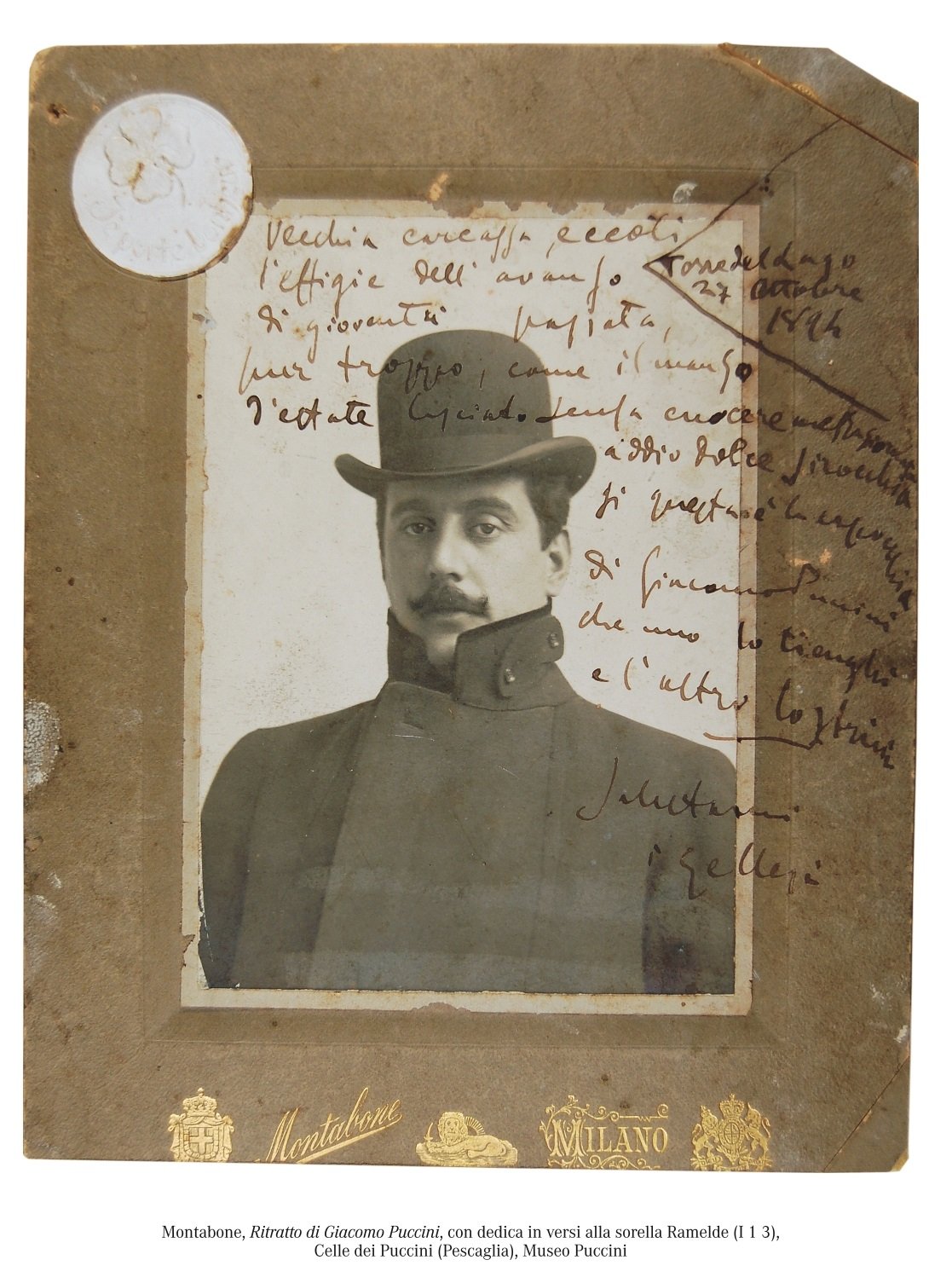
Giacomo Puccini described his poems as “dispersed verses” or as a nocturnal pastime to overcome hours of insomnia. He did not attribute particular artistic value to them. The collection of poems, skilfully organized and curated, nevertheless testifies to an incessant activity, which almost in a “chronicle” mode interprets Puccini’s biography. Puccini rhymes from the steamers of his travels and from hotel rooms. He pours from his homes and from the villas of friends. He does this by writing on what happens: a letterhead, a postcard, a photographic illustration. These are compositions inserted in the body of letters, sometimes in exergue, sometimes pinned to them. In other cases they take on the form of the dedication that accompanies the donated scores. It happens that they “dirty” an author’s
book or that they remain in a file of the Master.
It should be remembered that the predominant “humanistic” education involved the knowledge of metrics, the musical reading of Latin poets, and the accurate knowledge of the forms of rhetoric. The language for a country in formation was the foundation of the birth of a national culture and mastering its expression was a fundamental requirement that, going beyond the boundaries of the skills of professional “literati”, was cultivated by anyone who carried out an intellectual activity or a freelance profession. All the more so among musicians and in particular among opera composers, who had the necessary habit with the understanding and expression of the relationship between music and words. It is no coincidence that Puccini responds to Eugenio Checchi who questions him about his poetic disposition by recalling his youthful reading of Virgil’s musical verses.
However, it is a constant activity that touches the registers of mockery, mockery, satire, venting and bitterness. They possess some fundamental traits of the “goliardic” and “popular” genre. The often collective participation in the declamations, which manifest themselves before or after the poetic composition. We know that among the friends of La Bohème and also among the more mature ones of Gianni Schicchi the art of mockery and mockery was practiced. Another characteristic of goliardic poetry is the caricature trait, which intertwines the psychological profile and the body of the character, to which Puccini resorts with penetrating wit. The shift from “high” to “low” – and vice versa – of the poetic content is another declination: classical and mythological references, Dantesque quotations, allusions to opportunely modified opera verses addressed to the description of characters and situations and, on the contrary, figures and junctures paradoxically elevated by the cultured juxtaposition, sometimes by the nickname. References to food with a wealth of details on taste, quality or effects recall its genre. The puns and double entendres, these often related to the sphere of lived, imagined or recommended sex, populate the rhymes. The theme of vanitas is also collected from goliardic poetry and its intertwining with popular poetry with hints both to bodily decadence and to the transience of success. The explicit or alluded invectives against power, against the judgments of French critics and against the boredom of salons and receptions mark a section of the collection, but they also shine through as tone and content of other compositions. The family, the network of friends, the places, the premieres and performances, the loves, the travels, his works and those of other composers and even the management of money and household errands enter into the richness of the Maestro’s linguistic register, which on a widely goliardic, mocking, irreverent, obscene and sarcastic matrix, he expressed himself in compositions that more than occasional, become parts of a shared and personal songbook, restored to his overall knowledge, which, although not desired by the author, reveals a lot about the author.
This book gives us another chapter of Giacomo Puccini’s artistic sensibility. Just as the Master was more than just a lover of the figurative arts and a user of the camera, so he was a poet in his own way. I feel that there is a symmetry between the titles of the first exhibitions mentioned and the title of this dowsing contribution. The Master’s words introduce the specifics of his artistic and cultural interests: “For dreams and chimeras”. Giacomo Puccini and the figurative arts and then “Qual occhio al mondo”. Puccini photographer. One could basically allude to the need to understand the complexity not only of the composer, but of the intellectual in his entirety. «Dispersed verses» Puccini the poet sounds good to me.
Massimo Marsili