
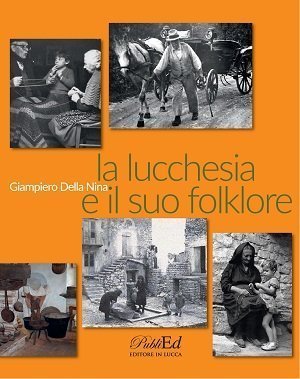
March 3, 2017, new presentation for “La lucchesia e il suo folklore”
Today, Friday 3 March at 5 pm, the book “La Lucchesia e il suo folklore” (ed. Publied) by Giampiero Della Nina will be presented in the municipal library of Borgo a Mozzano. Together with the author and moderator Marco Nicoli, Mayor Andreuccetti will also speak. The event is free admission, for further information contact the library itself (0583 888045 or biblioteca@nullcomune.borgoamozzano.lucca.it).
Meanwhile, the volume was presented at the Artemisia cultural center in Capannori, in Tassignano. The 280 pages, enriched with significant images, are divided in sequence according to the 12 months of the year: January puts the wig on the mountains, February adults and children wrap, March frees the sun from imprisonment, April adorns the street with beautiful colors, May lives among the music of birds, June hangs the fruits on the twigs, July ripens the crops in the sun, August makes them in bundles and puts them away, September with sweet bunches of grapes, October harvests and fills them, November arid leaves pile up on the ground, December kills the year and buries it.
With the interview method, the author was stimulated to talk about carnival and Lent – current themes in a very interesting period for a lover of traditions -, of customs and traditions of the month of March, then of spring rites, sacred representations, Easter, and so on. Topics that aroused the curiosity of those present, involved in dialogue and asking questions, thus contributing to the success of the initiative.
It was also recalled that in the mid-50s the Italian Federation of Popular Traditions was established, precisely to promote and protect Italian folklore also at an international level. And in Lucca these traditions are particularly numerous, so much so that in the second half of the 70s the then president of the Province of Lucca established the Center for Popular Traditions (editor’s note: unfortunately abolished in 2012) appointing Professor Gastone Venturelli, originally from the Municipality of Molazzana in Garfagnana, ethnologist, professor at the universities of Urbino and then Florence, as director. It was a flourishing of demonstrations, in particular of the “maggi”; testimonies and various material were collected in abundance, a fundamental documentation for scholars. Finally, it is hoped that in the various middle schools of the entire province there will be a newfound attention to “the way of being, thinking and interpreting the life of the Lucchese of the past, reconstructed through proverbs, legends, superstitions and traditions
(source: Lo Schermo)
