
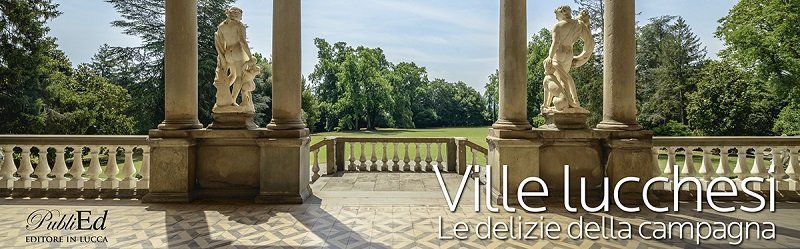
Friday, June 26, 2015 presentation of “Ville lucchesi. The delights of the countryside.”
from Lo Schermo.
24-06-2015 / Books / The editorial staff
LUCCA, 24 June – “Villas of Lucca. The delights of the countryside ” is the title of the first volume of an ambitious editorial project carried out by PubliEd, which will be presented on Friday 26 June, at 5.30 pm, at Villa Torrigiani. The work tells the long journey that unites the aristocratic villas of Lucca in the intertwining with the events of the most important families and families who have lived there. The first volume, already published, will be followed, in 2017, by “Giardini lucchesi. The theatre of nature between city and countryside”, dedicated to the theme of the garden as an autonomous expression of architecture built with nature.
Through purely historical features, combined with clear explanations of what was the architecture and stylistic imprint of each era, the author Maria Adriana Giusti describes the theatrical vocation of Lucca’s villas: an avenue that accompanies the gaze to the manor house, the garden that, together with the villa itself, inevitably predisposes to poetry. A volume in four languages – Italian, English, French and German for an unprecedented editorial operation in Lucca – accompanied by photos by Luca Lupi and cards by Gilberto Bedini that accompany the reader, the curious, the tourist, the dreamer on a profound journey beyond the threshold of the most precious monuments of the province.
Going back along the course of history to the fourteenth century, we discover a Lucca that is the undisputed protagonist of the new architectural course. A unique landscape that assigns our province the primacy of leader: it was in fact in these areas that the first rustic villas appeared early compared to the Italian panorama at the end of the Middle Ages. Castruccio Castracani’s residence in Massa Pisana, now Villa “La Principessa”, represents the first great example of this artistic novelty, which preserves a cozy and autonomous world within a boundary wall; The main building merges with the garden in a landscape momentum that continues into the vegetable garden and chapel, in an open dialogue with the surrounding nature. But the Lucca villa does not only represent the buen retiro of the nobles from the worries of city life. In fact, it combines the useful and the delightful: wealthy circles of artists dialogue with the more concrete traits of the dynamics of the countryside, giving life within the Forci estate of the Buonvisi family to the “Treatise on Agriculture” by Giovanni di Vincenzo Saminiati.
And it is in this phase, between the sixteenth and seventeenth centuries, that the Lucca villa develops those typical traits of harmony and homogeneity that distinguish it: compact and symmetrical volumes for the building contrast with the spectacularity of the nymphaeums in the gardens, where there are monumental fountains, caves and fairytale niches. Villa Buonvisi – Oliva in San Pancrazio, Villa Guinigi in Matraia and Villa Parensi in San Michele di Moriano: these are the villas that best represent this new course. With the advent of the eighteenth-century splendour, even the new aristocratic residences dress up for the holidays, inspired by other European centers such as Rome, Florence, Paris and Vienna. The new villas go from a harmonious and rational style to pomp and grandeur, transforming themselves into ideal places to host ceremonies, shows and celebrations. Scenographic artifices, frescoes and a strong taste for theatricality become central elements that can be found, for example, in the splendid Villa Santini Torrigiani in Camigliano (which the Marquis Nicolao Santini, ambassador of the Republic of Lucca to the court of the Sun King, decided to transform into “his Versailles”) and Villa Garzoni di Collodi.
